
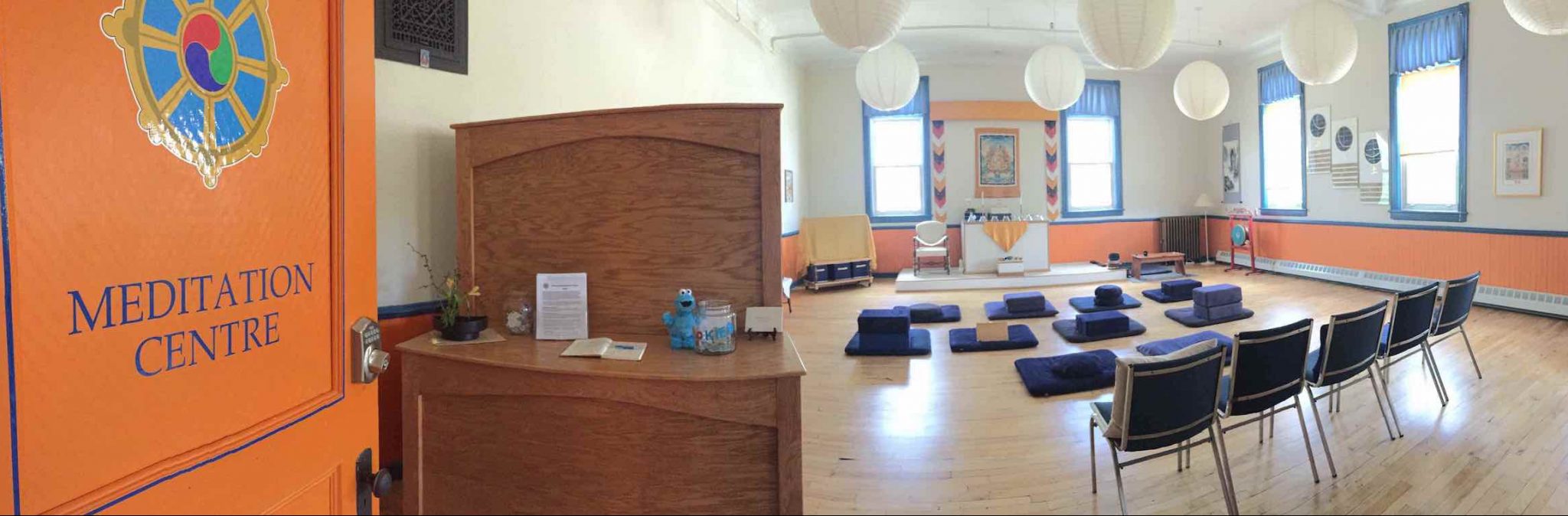
Entering and Exiting the Meditation Hall
Please arrive a few minutes early to avoid disturbing a meditation session in progress. Please leave your shoes in the hallway. You are welcome to put coats and bags in the cloakroom. No animals are permitted in the meditation hall except service dogs. There is no food in the meditation hall during sessions of meditation practice, but beverages are permitted in closed containers. Bowing while entering or leaving the meditation hall is a traditional mindfulness practice that we encourage but is optional. Please remember to turn cell phones off or set to silent mode.
After entering the meditation hall, find an unoccupied chair or mat, choose a meditation bench or whatever cushions you might need to make yourself comfortable, and settle in.
If you are new to the MBMC, please ask for the session leader and introduce yourself. If you have no prior experience with meditation, you are welcome to attend one of our regularly scheduled Introduction to Mindfulness Meditation sessions or to contact us in advance to arrange for personal instruction.
Those arriving after a session begins are asked to enter quietly, ideally during one of the periods of walking meditation; the same holds for those leaving before the session ends.
Leaving the Meditation Hall
Please take any meditation cushion or bench you have used back to the storage area. The large flat cushions remain in place on the floor.
Sunday Morning Meditation
Everyone is welcome to attend, although this session is primarily intended for those with previous meditation experience. Meditation instruction can be provided with prior arrangement.
After the shrine is opened, we begin with the following chants (chant books are provided*):
- The Four Dharmas of Gampopa
- Seven Line Supplication to Padmakara
- Supplication to the Takpo Kagyu
- The Heart Sutra
You are welcome to join in or just listen to the chanting.
* Traditionally, chant books and other practice texts are not placed on the floor.
At 9am please stand at your place while the timekeeper opens the shrine. When the timekeeper has arrived at their seat then all sit down together. The timekeeper might make and/or call for announcements of upcoming MBMC events before opening the session with three gongs
The chants are followed by alternating sitting (~20 minutes) and walking (~10 minutes) meditation periods ending at 11am. At that time, the timekeeper will lead the dedication of merit and then close the session with three gongs.
Walking Meditation
The timekeeper signals the beginning of walking meditation by ringing the gong once, saying “walking meditation” or simply “walking”.
- All stand and proceed to do walking meditation in a clockwise direction, not too fast and not too slow. The timekeeper sets the pace.
- The timekeeper will signal the end of walking meditation by striking the gandi. As soon as the gandi is struck, everyone should pick up their pace and walk briskly, still clockwise, to their seat, where they remain standing until the timekeeper sits down; then all sit down together.
- When everyone has settled, the timekeeper will strike the gong once to signal continuation of sitting practice.
Tuesday: Simple Sit
A no-frills meditation practice. The session starts with a short statement of contemplative material. This is followed by group meditation instruction if there are new partipants. We then sit until 11:00am. 10 minutes of optional walking meditation follow, allowing those who are looking for an abbreviated session to leave or arrive. A final sitting practice of about 20 minutes rounds off the session at 11:30am.
Those arriving after 10:30am are asked to enter quietly or to wait until the walking meditation period.
Wednesday Mornings
This meditation circle is facilitated by participants and welcomes all levels of meditators. The morning begins at 10:30 am with 20 minutes of seated meditation, then 10 minutes of walking meditation. This is followed by discussion of a reading from Comfortable with Uncertainty, by Pema Chödrön. People who attend this session appreciate the opportunity to reflect on the reading and share their experience with their own meditation practice. The circle finishes with 5 -10 minutes of seated meditation, including a dedication of merit, before closing at 11:30 am.
First Saturday: Introduction to Mindfulness Meditation
In our day-to-day life, we often spend a lot of time in pressured situations moving from task to task. Mindfulness meditation is designed to help us bring our bodies and mind together instead of the normal way of doing one thing and thinking about something else. Mindfulness is simply about being present and experiencing our world more fully
Each session runs from 10 – 11am on the first Saturday of each month, and includes meditation instruction, meditation practice, walking meditation and an opportunity for questions and discussion.
Symbolism in the Meditation Hall *
Meditation is about waking up; that is, interrupting habitual patterns of perceiving, feeling, and thinking in order to experience things directly. The meditation hall—for one example, through its bright colours—creates an environment to support the path of awakening. The focal point of the hall is the shrine, which serves to remind us about and orient us toward the wakeful qualities that are innate in all beings. The objects and images are symbolic, each one pointing to an aspect of the view, the training (path), or the full realization of this innate nature of wakefulness.
Crystal ball: Crystal represents the clarity of unborn mind, primordially awake, which is capable of accurately reflecting all perceptions of the phenomenal world.
Text (wrapped in brocade): Represents the dharma, particularly the teachings of the Buddha and other realized teachers, which is based on experience arising from meditation.
Flowers: Offerings of exertion; flowers are said to represent the paramita (“transcendental perfection” or virtue) of exertion.
Guru candle or lamp: Burned during group practice as a reminder of the continual presence of the teacher, which ultimately is our inherent wakefulness.
Candles: Offerings of meditation; light represents prajna, the flame of awakened intellect which illumines reality “as it is”.
Water bowls: Offerings of generosity to the lineage of enlightened beings; pure water is said to represent the inherent clarity and purity of mind.
Incense: Offerings of patience; incense is said to represent the paramita of patience which pervades all practice.*
*The above descriptions based upon the Vajradhatu Practice Manual (rev. ed., 1999).
Padmasambhava Thangkha
Like all shrine imagery in the non-theistic traditions of Buddhism, the thangka aims to remind viewers of qualities inherent in themselves and their lives. The details of the iconography are highly symbolic, each one pointing to an aspect of the view, the training, or the full realization of this basic nature.
Sakyong Mipham Rinpoche
The large thangka (scroll painting) over the shrine depicts the Buddhist teacher Padmasambhava (Lotus-Born). Also widely revered as Guru Rinpoche (Precious Master), he is an 8th-century Indian tantric master credited with bringing Vajrayana Buddhism to Tibet. Known as the “Second Buddha”, he was invited by King Trisong Detsen to subdue negative forces and help build Samye Monastery, the very first Buddhist monastery in Tibet.
The central symbols found within a Padmasambhava thangka include:*
- The Lotus Throne & Headdress: He sits upon a lotus, symbolizing his miraculous birth from the nectar of a lotus in Lake Dhanakosha. His five-petaled hat represents the Five Buddha Families, topped with a sun, a moon, and a vulture feather to denote the ultimate realization of Dzogchen (Great Perfection).
- The Vajra (Right Hand): Held at the heart, this symbolizes unshakable compassion and the indestructible, diamond-like nature of the awakened mind.
- The Skull Cup & Immortality Vase (Left Hand): Cradled in his lap, the skull cup represents realized wisdom, while the vase contains the nectar of eternal life and deathless wisdom.
- The Khatvanga (Trident Staff): Cradled in his left arm, it represents his spiritual consort and the unity of bliss and emptiness. The three heads on the staff symbolize the Three Kayas (the bodies of a Buddha), while nine iron rings represent the nine stages of spiritual paths.
- Regal Attire & Colors: He wears a combination of monastic robes and royal silks, signifying his royal heritage (as a prince) combined with absolute renunciation and wisdom.
Tara (framed line drawing): Representations of the Tara symbolize active compassion, fearlessness, and spiritual healing. Her right hand is typically held palm-up in the Varada mudra (granting generosity and blessings), while her left hand at her heart holds the stem of a lotus flower. A blue or white lotus symbolizes purity, spiritual awakening, and the capacity to rise untainted from the “mud” of cyclic existence (samsara).
* descriptions of symbolism compiled from various online sources